
The rise of use case-driven market data is creating new challenges
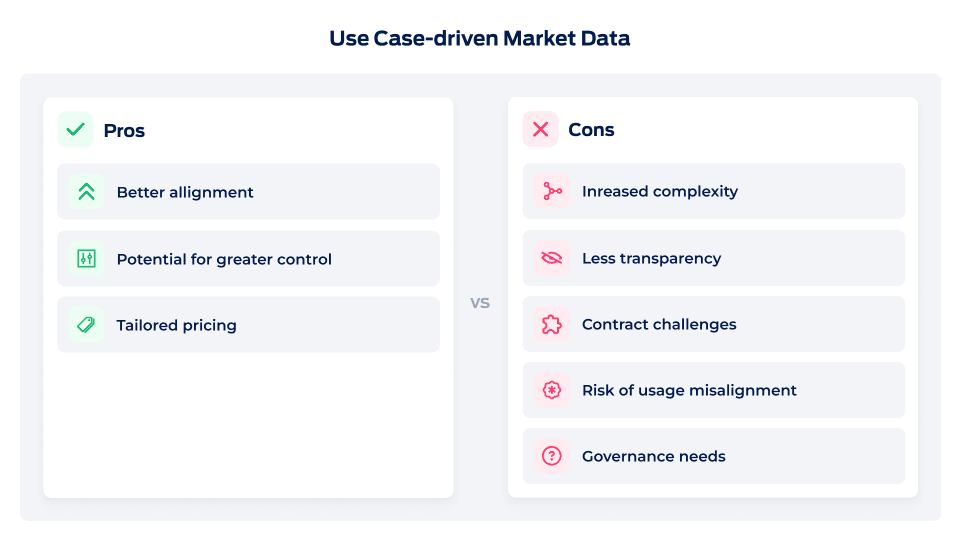
Financial institutions are clearly moving towards use case-driven market data management. On paper, this makes a lot of sense. It promises better alignment between data and business needs, along with greater control over costs.
In practice, however, it is not making things simpler. If anything, it is introducing an additional layer of complexity that many organisations are still trying to understand.
This shift is not just about how market data is consumed. It affects how the data is requested, how contracts are structured, and how organisations stay compliant.
Table of contents
Why the market is moving towards use cases
Traditionally, market data management seemed relatively straightforward. A team needed data, often from a well-known market data vendor such as Bloomberg or LSEG, and a vendor manager would arrange access through an enterprise deal. The data would then be distributed across the organisation. That model is gradually changing.
Instead of starting with a market data vendor or a dataset, organisations are beginning with the actual business need. For example, ensuring that end of day prices for a specific set of instruments are consistently available for reporting or regulatory purposes.
This may sound like a subtle shift, but it fundamentally changes the conversation. The focus moves away from “which market data vendor do we use” to “what do we actually need to achieve”, and only then to where the data should come from.
Pricing is becoming use case dependent
At the same time, market data vendors are moving away from more predictable pricing structures.
Where it once felt like selecting from a menu, with relatively predictable pricing per data set, pricing is now increasingly based on how data is used. Market data vendors want to understand the context to assess the added value of their content: who is using the data, in which systems, how often, and for what purpose.
This includes distinctions such as display versus non-display, front office versus back office, and professional versus non-professional usage. At the same time, AI-driven use cases are becoming more common, adding another layer of complexity.
The result is that pricing becomes more tailored, but also significantly less transparent. Two organisations using similar data may end up with very different pricing simply because their use cases are defined differently. This may be fair and explainable, but market data consumers do not always see it that way.
Contracts are becoming harder to manage
As pricing becomes more use case driven, contracts follow the same pattern.
Each market data vendor has its own way of defining use cases. Terms are not standardised, and similar concepts are described differently across market data vendors. Derived data is a good example, as interpretations can vary widely.
For organisations working with multiple market data vendors, this quickly leads to a complex landscape of contracts that are difficult to align. Vendor managers are expected to interpret these differences and translate them into something the business can understand and follow.
In reality, this becomes increasingly difficult to manage without a clear structure and strong governance.
Usage is often unclear and misaligned
Another recurring issue is that organisations often lack a clear understanding of how their data is actually used.
In many cases, more market data is requested than is strictly necessary. This is partly driven by uncertainty It feels safer to request more rather than risk missing something critical later.
However, this leads to inefficiencies. Market data that is requested is not always fully used, and the difference between what is contracted and what is actually consumed can be significant.
At the same time, usage does not always align with the agreed use cases. Data may be used in additional systems or contexts that were not originally considered. This is rarely intentional, but it does introduce both cost and compliance risks.
The growing need for measurement and governance
In a use case-driven model, assumptions are no longer sufficient.
Organisations need to understand, in detail, who is using which data, for what purpose, and under which contractual conditions. This is important not only for internal cost control, but also for demonstrating compliance to vendors and regulators.
Without this level of visibility, it becomes difficult to manage data usage effectively or to have meaningful discussions with market data vendors about pricing and contracts.
This is where many organisations currently lack the necessary insight and tooling.
In addition to measurement and visibility, organisations also need mechanisms to actively control data usage. For example, by adding an authorisation layer that ensures only approved users or applications can access specific data.
Taking back control in a changing landscape
The move towards use case-driven market data management is not optional. It is being driven by both vendors and internal pressure to manage costs more effectively.
At the same time, it introduces new challenges. Contracts become more complex, pricing less transparent, and the responsibility for understanding and controlling data usage shifts further towards the organisation.
Many institutions are trying to balance this with internal standardisation, for example by offering Data as a Product through central platforms. This creates an additional layer where external complexity needs to be managed within an internally simplified model.
Bringing these two worlds together is not straightforward.
Organisations that succeed will have a much better understanding of their data usage, stronger control over costs, and a more balanced position in discussions with vendors. Those that do not will continue to face inefficiencies, limited transparency, and increasing complexity.
Curious how this works in practice? Get in touch, or download our processing overview.
