
Why complete data lineage matters in market data management
An incorrect price appears in a downstream application. The data appears valid, yet the result is incorrect. Was the issue caused by the market data vendor, a validation rule, a configuration change or a manual intervention before distribution?
Answering these questions requires complete visibility of the market data journey. Organisations need to understand where data originated, how it was processed, who interacted with it and how it ultimately reached downstream systems. This is where complete data lineage becomes essential.
Within the BIQH Market Data Platform, complete data lineage provides end to end traceability across the entire market data lifecycle. From acquiring market data from external vendors and validating incoming feeds to governing operational changes, distributing trusted data and monitoring its usage, every stage remains transparent and historically traceable. This enables organisations to investigate issues more efficiently, support regulatory audits, demonstrate compliance and maintain confidence in the integrity of their market data.
Table of Contents
What is data lineage
According to the Data Management Association, data lineage is “a description of the pathway from the data source to its current location and the alterations made to the data along that pathway.”
In simple terms, data lineage provides complete visibility of the journey market data takes. It shows where data originates, how it moves through the platform, which validations and transformations are applied and how it reaches downstream systems. Rather than providing a snapshot at a single point in time, data lineage creates a transparent and traceable record of how market data evolves throughout its lifecycle.
The business value of complete data lineage
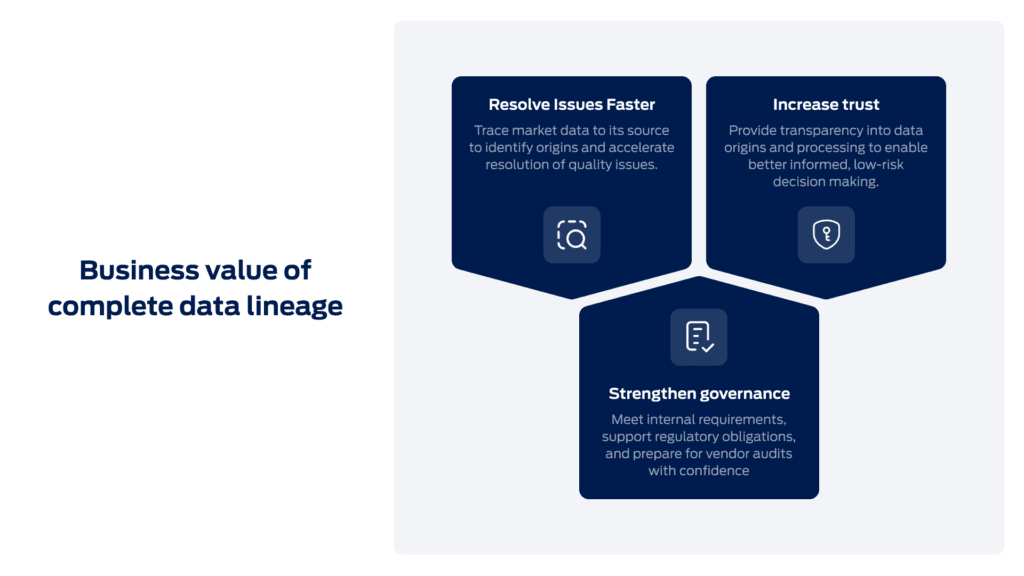
Complete data lineage provides far more than visibility across the market data lifecycle. It delivers measurable business value by making market data easier to understand, govern and trust. As a result, organisations can operate more efficiently, reduce risk and make decisions with greater confidence.
Resolve issues faster
When unexpected values or discrepancies occur, complete data lineage enables organisations to trace market data back to its source, understand what changed and identify where an issue originated. This significantly reduces the time required to investigate data quality issues and accelerates resolution.
Strengthen governance and compliance
A complete record of how market data is received, validated, distributed and consumed helps organisations meet internal governance requirements, support regulatory obligations and prepare for vendor audits with confidence. The ability to demonstrate actual market data usage also strengthens discussions with data providers and supports compliance with contractual agreements.
Increase trust in market data
Confidence in market data depends on understanding where it originated, how it has been processed and how it is being used. Complete data lineage provides this transparency, enabling users to make better informed decisions while reducing the risk of relying on incomplete, outdated or unverified information.
How The BIQH Market Data Platform enables complete data lineage
From source to platform
Complete data lineage begins the moment market data enters the platform. Organisations need visibility of where data originated, when it was received and how it entered the platform.
The BIQH Market Data Platform captures this information from the very beginning of the data lifecycle. Every imported record remains linked to its originating data provider through provider identifiers, while feed configurations, processing activities and import executions are historically recorded. This creates a transparent record of how market data entered the platform and establishes the first link in the complete data lineage.
Ensuring data quality and governance
Not every record passes validation immediately. When exceptions occur, organisations need complete visibility of what happened before data continues through the platform.
The BIQH Market Data Platform supports controlled validation workflows that enable exceptions to be reviewed, corrected, approved or rejected within a governed process. Every manual intervention is historically recorded, including who made the change, what was changed, when it occurred and who approved the outcome. This ensures every decision made during validation remains transparent, auditable and fully traceable.
Creating and maintaining a trusted Golden Copy
Once market data has been validated, it is imported into the Golden Copy, where it is standardised within a controlled internal data model while remaining linked to its originating provider.
Complete data lineage continues as market data evolves. The platform records key lifecycle events, including when records are created and subsequently modified. Every change remains linked to its source, whether it originates from a market data provider or an approved manual correction. This allows organisations to understand how market data has evolved over time while preserving a complete historical record.
Delivering trusted market data
Complete data lineage extends beyond data processing into distribution. The BIQH Market Data Platform maintains version histories of schedules, publication settings and output configurations, preserving a complete snapshot of every configuration over time.
Historical versions can be reviewed, compared and, where required, restored. This makes it possible to reconstruct the exact distribution configuration that was active at any point in time. Combined with comprehensive audit logs, organisations gain complete visibility of both distribution activities and configuration changes as part of the end to end data lineage.
Understanding market data usage
Understanding how market data is consumed is just as important as understanding how it moves through the platform. Organisations need visibility of which data is requested, which applications and users consume it and how frequently it is accessed. These insights are essential for validating contractual usage, responding to vendor audits and understanding market data consumption across the business.
Organisations operating under contractual agreements with market data vendors must be able to demonstrate how market data is actually used. During a vendor audit, they need to show how market data has been accessed, requested and consumed.
The BIQH Market Data Platform provides detailed request, retrieval and usage statistics that can be analysed by customer, application, provider, attribute and time period. These insights support contractual discussions with market data vendors, help validate usage against contractual agreements and provide a clear understanding of market data consumption across the organisation.
Conclusion
Market data is only as valuable as the confidence organisations have in it. Without visibility of where data originates, how it changes and how it is used, even minor issues can lead to lengthy investigations, compliance challenges and unnecessary business risk.
Complete data lineage changes this by connecting every stage of the market data lifecycle. It gives organisations the transparency needed to trust their market data, resolve issues more quickly and confidently demonstrate how market data has been managed from source to consumption.
As market data ecosystems become increasingly complex and regulatory expectations continue to evolve, complete data lineage is no longer simply a technical capability. It is a fundamental requirement for effective market data management.
Want to see how the BIQH Market Data Platform enables complete data lineage? Get in touch with our team to arrange a demonstration or download our factsheet and discover how BIQH can help you gain complete visibility of your market data.
