
Why T+1 Data Architecture Starts with a Central Data Layer
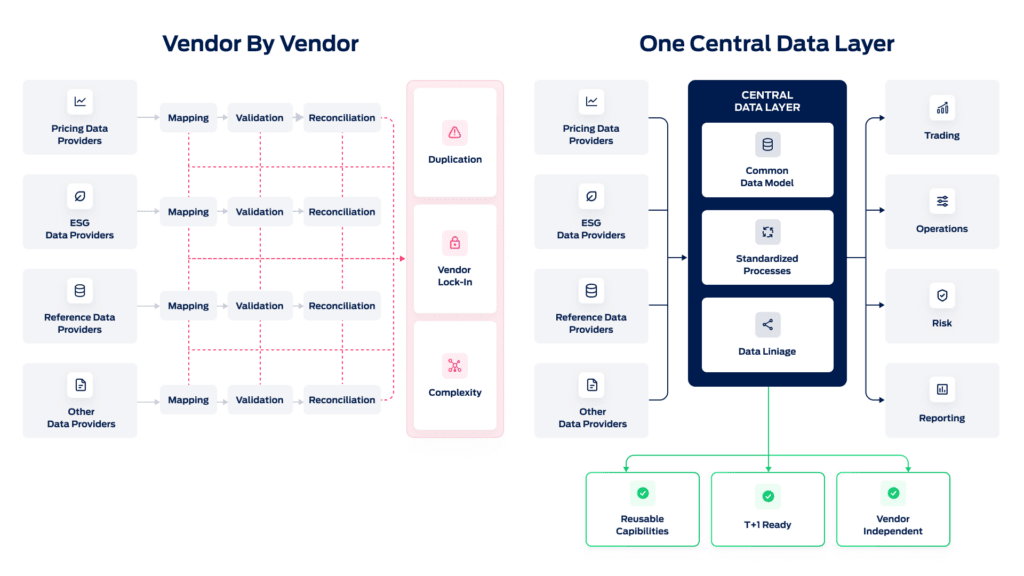
Across the financial industry, institutions are investing in initiatives to modernise how market data is managed and distributed across the organisation, helping to accelerate operational processing. As T+1 settlement shortens processing windows and increases operational pressure, the need for a scalable T+1 data architecture is becoming more important.
Many organisations respond through vendor specific initiatives. A pricing feed is upgraded, a new data provider is onboarded, or an operational process is redesigned to meet an immediate business requirement. While these projects often achieve their intended objectives, they can also add complexity over time.
The question is not simply whether existing systems can support T+1 settlement. It is whether a T+1 data architecture can support continuous change without forcing teams to solve the same challenges repeatedly across different vendors and datasets. Answering that question requires an understanding of why organisations continue to adopt a vendor-by-vendor approach, how that approach creates complexity and dependency, and why a vendor-agnostic alternative can deliver greater long-term value.
Table of Contents
Why organisations take a vendor-by-vendor approach
Most organisations do not intentionally create fragmented data architectures. In many cases, fragmentation develops gradually through organisational silos, distributed ownership, and project-based funding models. Different teams are responsible for different data domains, and success is often measured against local objectives rather than broader architectural outcomes.
In this environment, data challenges are typically addressed at the source. When a new vendor is onboarded, a feed requires improvement, or a data quality issue emerges, teams focus on solving the immediate requirement. This often involves creating mapping logic, validation rules, reconciliation processes, and exception handling workflows tailored to a specific vendor or dataset.
While these initiatives frequently achieve their intended objectives, they also lead to the repeated development of similar capabilities across the organisation. Over time, multiple versions of the same controls and processes begin to emerge, increasing complexity and making it more difficult to maintain a scalable T+1 data architecture.
The result is not only duplication. It also creates growing dependency across the data landscape, with knowledge of specific integrations, processes, and data flows often concentrated within a small number of individuals.
How vendor lock in creates complexity
Each time a capability is rebuilt around a specific vendor, a new dependency is created alongside it. Over time, those dependencies can evolve into vendor lock-in.
Vendor lock-in is often associated with the vendor itself, but in many cases the dependency is created by the way a vendor is integrated into the wider data landscape. As capabilities become tied to vendor-specific interfaces, workflows, business rules, and operating models, replacing a provider becomes increasingly difficult. The organisation is no longer dependent on the vendor alone, but also on everything that has been built around it.
The challenge is that these dependencies rarely remain isolated. As new vendors, datasets, and requirements are introduced, existing integrations often need to be adapted, extended, or replicated. What starts as a solution for one vendor can quickly become a recurring requirement across many others.
This is where a central data layer can make a difference. Rather than creating the same capabilities repeatedly, organisations can establish them once and make them available across the wider data ecosystem.
Building a scalable T+1 data architecture
A central data layer changes where data is prepared and managed. Instead of applying transformations, validations, and business rules separately across multiple projects, data from different vendors is collected, validated, and standardised before reaching downstream systems and teams. This creates a consistent foundation for a scalable T+1 data architecture.
Once data enters the central layer, common standards and controls can be applied across all sources. Pricing data, reference data, and other datasets are aligned to shared data models, while validation rules are managed centrally rather than recreated across multiple workflows. As a result, data quality is easier to monitor, data lineage is easier to track, and governance becomes more consistent across the wider data landscape.
This also changes how new vendors are onboarded. Rather than requiring downstream processes to adapt to every new feed, source, or format, vendors are aligned with standards already established within the central layer. Existing consumers continue to work with the same data models and controls, while new sources can be onboarded without disrupting downstream processes.
The BIQH Market Data Platform is built around this principle, providing a centralised data layer for standardising, validating, and distributing vendor data. The benefits of this approach extend well beyond current T+1 requirements.
Why a central data layer delivers long term value
By establishing shared standards, validation processes, and data models within a T+1 data architecture, organisations can address T+1 requirements through a common framework rather than multiple vendor specific initiatives. It also becomes easier to maintain consistent data lineage across vendors and datasets, reducing the effort required to trace and govern data as the landscape evolves.
Importantly, the capabilities needed to support shorter settlement cycles are often the same capabilities required to manage future change. New pricing providers, ESG datasets, benchmark sources, and regulatory obligations all introduce additional data into the organisation. A central data layer provides a structured way to onboard and manage these changes without repeatedly creating new controls, processes, and operating models.
This is why a central data layer delivers greater value than a collection of vendor specific T+1 projects. Rather than addressing today’s requirements in isolation, a T+1 data architecture provides a foundation that can adapt to new vendors, datasets, and market developments using the same underlying framework. The result is not simply readiness for T+1, but an architectural capability that continues to deliver value long after the transition is complete.
Conclusion
T+1 creates an opportunity to rethink how market data is managed across the wider data landscape. While vendor specific initiatives can address immediate requirements, they often lead to duplicated capabilities, fragmented processes, and increasing complexity over time. A central data layer offers a more sustainable approach by bringing shared standards, controls, and processes together within a single T+1 data architecture.
The most effective way to prepare for T+1 is not to solve the same challenge through multiple vendor specific projects. It is to establish a central data layer that supports the transition through shared standards, controls, and processes while creating a foundation for future vendors, datasets, and business requirements. The result is a T+1 data architecture that remains valuable long after the transition itself is complete.
How BIQH helps
At BIQH, we help financial institutions build a scalable, vendor-independent data architecture that supports T+1 and future operational change. Our approach focuses on creating a central data layer that reduces complexity today while providing the flexibility to evolve tomorrow.
With BIQH you can:
- Centralise data management – Create one vendor-independent data layer for market data.
- Reduce complexity – Eliminate duplicate mappings, validations and operational controls.
- Avoid vendor lock-in – Decouple business processes from individual data providers.
- Onboard vendors faster – Integrate new providers without disrupting downstream systems.
- Improve data quality – Apply consistent validation, governance and business rules across all data sources.
- Build for the future – Create a scalable architecture that supports T+1 and future regulatory or business requirements.
- Increase operational efficiency – Reduce manual effort, operational risk and ongoing maintenance.
Discover how the BIQH Market Data Platform provides a centralised data layer for a scalable T+1 data architecture. Download our factsheet or get in touch.
